![[Banner] Láma Ole during the teachings](./thm/new3/img/b2_ucenia_o.jpg "Láma Ole during the teachings")
We see all beings and ourselves as a part of a totality and gain a deep understanding of others' experience through this insight and realization.
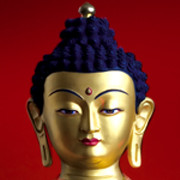
Buddha Shakyamuni
The one who reached the goal · 6th century BCE
“Do not believe my words merely because the Buddha spoke them. Examine them all thoroughly. Be your own guiding light.”
The founder of Buddhism, Siddhartha Gautama, a prince of the Shakya clan, was born some 2,500 years ago in Lumbini, in what is now Nepal. Tradition holds that this took place during the full moon of May. He grew up in the royal palace, surrounded by beauty and wealth. When, at the age of 29, he ventured beyond its walls for the first time, he saw first an old man, then a sick man and finally a dead man, which shook him deeply. He realised that he could find nothing in his life that was lasting, nothing he could truly rely on, and so he left the palace to meditate in the mountains and forests of northern India. After six years of searching, he recognised the nature of mind in deep meditation and attained enlightenment at the place known today as Bodhgaya. He recognised the essence of mind and became a Buddha.
For the following 45 years he taught, showing what is truly real and what is impermanent, and passing on methods for attaining lasting happiness.
To those who had strong trust in their own Buddha nature, the Buddha gave the teachings of the Vajrayana, the Diamond Way. He appeared to them in forms of energy and light, or directly transmitted to them the experience of enlightened mind - the Great Seal (Sanskrit: Mahamudra).
It is said that for as long as intelligent life exists on Earth, 1,000 Buddhas will appear; only three of them, however, will transmit the teachings of the Vajrayana. The basic Buddhist teachings can be preserved in texts. The Vajrayana, however, requires not only the Buddhist tantras but also an unbroken lineage of transmission through a realised teacher, and oral transmission and explanation are likewise indispensable.
In 1999, by General Assembly resolution 54/115, the United Nations officially recognised Vesak - the day of the May full moon, on which Buddhists all over the world commemorate the birth, enlightenment and passing of the Buddha - as an international day of observance. In doing so, it acknowledged the contribution that Buddhism has made to the spiritual heritage of humanity for more than two and a half millennia.
The 16th Karmapa
Rangjung Rigpe Dorje
King of yogis · 1924–1981
“If you have 100 percent dedication and confidence in the teachings, then every living situation can be a part of the practice. You can be living the practice instead of just doing it.”
Every Karmapa manifests extraordinary qualities according to the needs of his students and of society. In general, he displays aspects of enlightenment. The life of H.H. the 16th Karmapa shows the true meaning of the name Karmapa, which means activity of all buddhas. His symbol is the Black Crown. The 16th Karmapa Rangjung Rigpe Dorje was a great master who displayed intuitive wisdom, joy and loving kindness. His compassionate activity for the benefit of all beings went beyond words and concepts.
The 16th Gyalwa Karmapa, supreme spiritual head of the Karma Kagyu lineage, one of the four main schools of Tibetan Buddhism, was born in the province of Derge in eastern Tibet. After the Chinese invasion and occupation of the country in 1959, he was forced to flee Tibet. Together with a group of monks and high lamas he fled through Bhutan to India. Rumtek Monastery in the state of Sikkim became his new principal seat in exile. Under the guidance of the 16th Karmapa, the Karma Kagyu lineage not only survived the flight from Tibet but also went on to flourish. Hundreds of Buddhist centres were founded across the world, where those interested can encounter the timeless teachings and methods of the Buddha.
Rangjung Rigpe Dorje was the first Karmapa to travel outside Asia. During the 1970s he made several journeys to Europe and North America, contributing significantly to the transmission and spread of Tibetan Buddhist teachings in the West. He first visited Europe in December 1974, when he came to Copenhagen at the invitation of his first Western students, Ole and Hannah Nydahl. In 1976 he arrived in New York and set out on a tour of the United States. The following year he returned to Europe, visiting Sweden, Denmark, Germany, the Netherlands, France and the United Kingdom. He travelled to the West once more in 1980.
His Holiness the 16th Gyalwa Karmapa passed away on 5 November 1981 in a hospital near Chicago, USA. His body was cremated at Rumtek.